
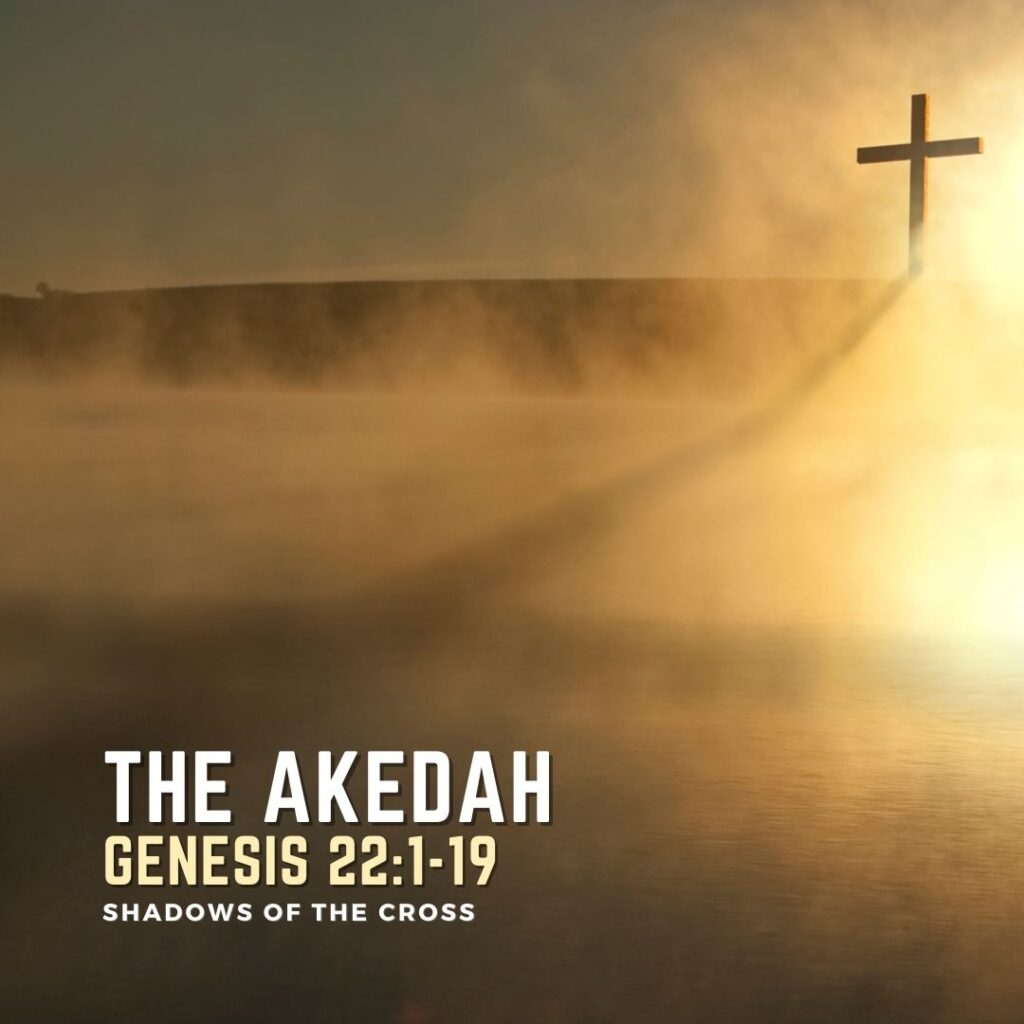
Shadows of the Cross: The Akedah – Genesis 22:1-19
As we come closer to the Easter and Passover period in our calendars, it would be good to have a look at the prophecies concerning the first coming of the Messiah and more specifically his death and resurrection.
The first prophecy of the Messiah is found in Genesis 3:15, it is also the first prophecy of the anti-Christ. It is interesting that the prophesy states that the Messiah will be of the seed of the woman, this is unusual as the seed line is usually recorded as that of the male seed.
It is not until a later revelation in Isaiah 7:14 where God Himself was to give a sign, and that sign is that the virgin shall conceive and give birth to a son and name him Emmanuel; meaning, God with us. The sign is that a virgin shall give birth to a male child and this is reaffirmed and fulfilled in Matthew 1:19-25.
In Genesis chapter 22:1-19, God tests Abraham by telling him to take thy son, thy only son and take him to the land of Moriah and offer him as a burnt offering on a mount on which I will tell you. Now we know that Abraham has an older son by the name of Ishmael. The reason God calls Isaac, Abraham’s only son, is because he is the son of the promise.
It is through Isaac and not Ishmael that the Messiah would come. Isaac has twin sons, Esau and Jacob and it is through Jacob and not Esau that the line through which the Messiah will come continues. Jacob has twelve sons but it is through his son Judah that the seed line of the Messiah continues.
It is interesting to note that this passage is called the Akedah by the Jews, meaning “binding,” in reference to the binding of Isaac. The (a)typology in this passage is that Abraham and Isaac are a type of God the Father and God the Son.
Just as Abraham is to sacrifice his son Isaac on Mt Moriah, this foreshadowed God the Father actually sacrificing his Son, the second person of the Triune God on the same mountain, now known as Mt. Zion.
They travel three days to a mountain in the land called Moriah. This mount in Moriah is today known as Mt. Zion on which the city of Jerusalem is situated. This is confirmed in II Chronicles 3:1, where Solomon is to build the temple on Mt. Moriah, the place the Lord appeared unto his father David.
Isaac is a picture of Jesus who carries the cross to the place of the crucifixion just as Isaac carried the wood to the place of the sacrifice. They leave the servants at the foot of the mountain, just as Jesus tells his disciples that whither I go, thou canst not follow me now, John 13:36.
Abraham carries the knife and fire for the sacrifice and it is he that will sacrifice his son Isaac on Mt. Moriah just as God the Father actually sacrificed God the Son on the very same mountain as the ultimate sacrifice for our sins. Isaac is the one that carries the wood up the mountain just as Jesus carried the cross to the place of His crucifixion.
In Genesis 22:7, Isaac asks his father Abraham, there is the fire and the wood but where is the lamb for a burnt offering. In verse eight, Abraham responds by saying that God will provide Himself, a lamb for the burnt offering, and two thousand years later God provided his only begotten Son, the Lamb that takes away the sin of the world, as the propitiation sacrifice for the removal of our sins; for those who would believe in the death, burial, and resurrection of Yeshua the Messiah.
Genesis 22:9 states that Abraham prepared the altar, laid the wood, and bound his son Isaac. Most people think of Isaac as a boy, but he was actually a young adult man at this time. Nowhere in the text does it say that Isaac questioned his father on this or resisted in any way to the binding and the laying of him on the altar as the sacrifice. Isaac is silent, just as Jesus went willingly to the cross, as a lamb to the slaughter, He was silent.
The question should be asked as to why Abraham was willing to sacrifice his son Isaac, the seed line through which the promise of the Messiah was to come. The answer is that at this point in his life Abraham had come to fully trust in the Lord. He had made mistakes in the past and had seen God’s faithfulness to him, so now he is obedient and understands that the God he serves is a faithful God that keeps His promises. If God said that Isaac was the son of promise then Abraham understood that if he is obedient to sacrifice Isaac then God will have to resurrect him in order to keep His promise of Isaac being the promised seed line through which the Messiah would come.
Genesis 22:12-14. The Angel of the LORD stops Abraham from killing his son and he sees a ram caught in a thicket and uses the ram as the burnt offering. He then names the place as Jireh, as it is said, in the mount of the Lord it shall be provided. Notice that the explanation for the naming is yet future; “it shall be provided.” Abraham was not referring to the sacrifice he just made but to a future one to made at this very same location. The death, burial, and resurrection of the Messiah on Calvary.
Genesis 22: 15-18, is God blessing Abraham for his obedience. The blessing is that his seed shall be multiplied like the stars of the heavens or the sand upon the seashore and that in his seed all the nations of the earth shall be blessed.
Verse nineteen though is peculiar. It states that Abraham returned to his men, they went together to Beer-sheba, and Abraham dwelt there. Notice that there is no mention of Isaac in the text. Obviously, he did come down with his father but that is not stated in the text. In fact, Isaac is not seen again in the narrative until Genesis 24:64 when he meets his bride Rebekah, brought to him by Abraham’s servant Eliezer – meaning God is help.
This foreshadows the fact that after Jesus’ death, burial, and resurrection, He ascends to heaven and we will not see him again until He comes for His bride at the rapture, which the Holy Spirit – another helper, has being preparing.
Fresh Truth Ministries
The Holy Bible
The commentary on Genesis by Arnold Fruchtenbaum
Koinonia House: Chuck Missler – Study on the Akedah
(a) – Typology: (or typological symbolism) is a Christian form of biblical interpretation that proceeds on the assumption that God placed anticipations of Christ in the laws, events, and people of the Old Testament
The Old and New Testaments had always given the liturgy a historical dimension, expressed not least in the typological linking of Old Testament “types” to New Testament “antitypes” (“antitype” means “imprint”: the term is from die-stamping and has nothing to do with hostility). — Alexander Murray.
Shadows of the Cross